
Alumina ceramics are widely used in electronics, aerospace, and cryogenic engineering due to their excellent insulation, high-temperature resistance, and chemical stability.
Among their key electrical properties, low-temperature resistivity is critical for evaluating insulation reliability, directly affecting device safety and stability in low-temperature environments.
Studying the low-temperature resistivity of alumina ceramics helps improve material evaluation systems and provides a scientific basis for designing devices used in extreme conditions.
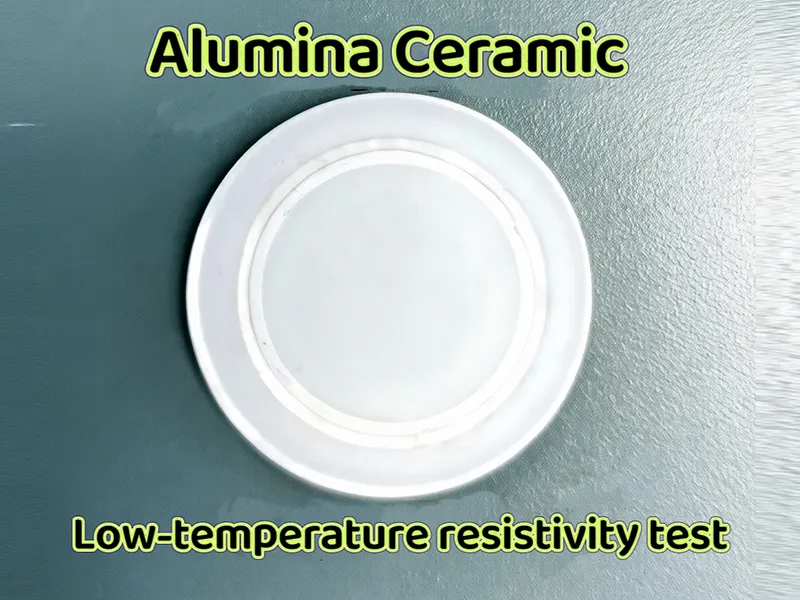
Testing Method and Procedure
Accurate low-temperature resistivity measurement requires strict control of both sample preparation and testing conditions.
Before testing, samples should be properly cleaned to remove surface contamination and moisture. Sample dimensions (diameter and thickness) are measured precisely, typically using a caliper, and averaged over multiple points to reduce error. At least three samples are recommended to ensure repeatability.
The test temperature is controlled from -55°C to room temperature, using a vacuum chamber with precise temperature control (±1°C). This setup minimizes temperature fluctuation and environmental interference.
Measurement Techniques
Due to the high resistivity of alumina ceramics, measurement methods such as the two-probe method combined with a three-electrode system are commonly used, following ASTM D257 standards.
Several factors significantly influence test results:
- Doping elements: Additives such as Cr₂O₃ and MnO₂ can form solid solutions with Al₂O₃, reducing resistivity. SiO₂ tends to accumulate at grain boundaries, also lowering resistivity.
- Sintering conditions: Samples sintered at higher temperatures (e.g., 1550–1600°C) generally show lower resistivity compared to those sintered at 1500°C due to grain growth and reduced porosity.
- Humidity effects: Surface resistivity is highly sensitive to humidity. When relative humidity increases from 40% to 100%, resistivity may decrease by 3–4 orders of magnitude.
Practical Significance
Low-temperature resistivity testing provides important guidance for material selection and optimization.
For example, in military or aerospace electronics, materials are often required to maintain resistivity above 10¹² Ω·cm at -55°C to ensure reliable insulation performance.
Test results also support material design by optimizing doping composition and sintering processes, enabling precise control of electrical properties for different applications.
Conclusion
Low-temperature resistivity testing is a key method for evaluating the electrical performance of alumina ceramics.
Accurate results require careful control of testing procedures and influencing factors.
With the continued development of cryogenic engineering and advanced electronics, this testing approach will play an increasingly important role in supporting high-performance ceramic materials for demanding applications.