MatMeas Ferroelectric Hysteresis Loop Measurement
Testing Function
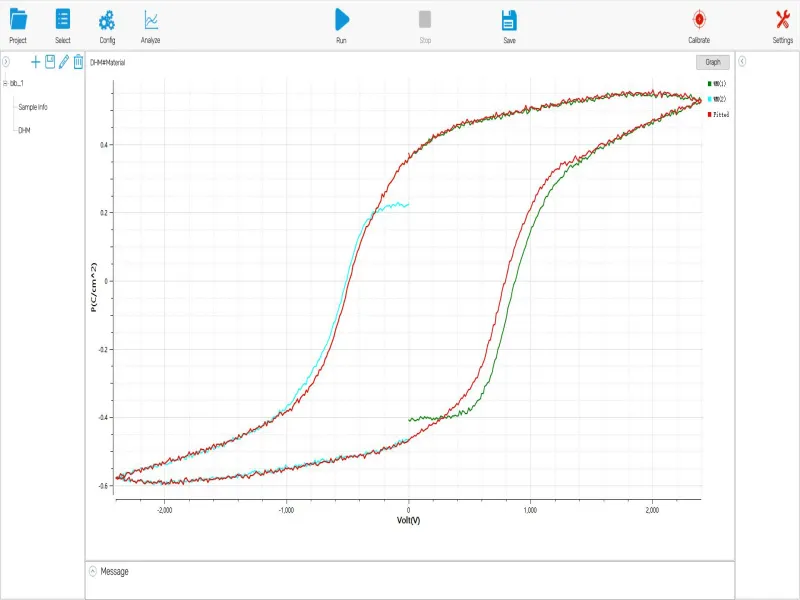
Under the action of a relatively strong alternating electric field, the polarization intensity P of ferroelectric materials varies nonlinearly with the applied electric field. Within a certain temperature range, P behaves as a double-valued function of the electric field E,exhibiting a hysteresis phenomenon. This P-E (or D-E) loop is referred to as the ferroelectric hysteresis loop.
Testing Principle
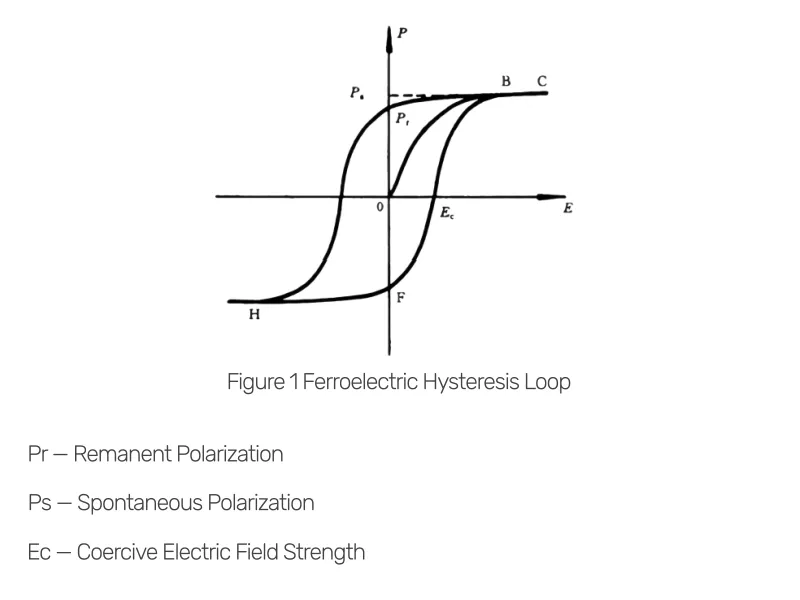
Under a relatively strong alternating electric field, the polarization intensity P of ferroelectric materials changes nonlinearly with the applied electric field. Within a certain temperature range, the polarization intensity P behaves as a double-valued function of the electric field strength E, resulting in a hysteresis phenomenon and forming the relationship curve between polarization intensity P and electric field strength E as shown in Figure 1, which is commonly referred to as the ferroelectric hysteresis loop.
This standard adopts the Sawyer-Tower circuit to measure the ferroelectric hysteresis loop. The alternating electric field is supplied by an ultra-low-frequency high-voltage source, and the hysteresis loop is recorded using an X-Y function recorder. Based on the measured hysteresis loop, the coercive electric field strength Ec, remanent polarization Pr, and spontaneous polarization Ps are calculated.
Testing Conditions
1. Test Parameters: Ec, Pr, Ps
2. Measurement Range: (10–1000) × 10⁻¹² C/N
3. Measurement Accuracy: ≤ 1%
4. Temperature Error: ≤ ±2 °C
Sample Requirements
1. Recommended sample dimension: t ≤ 1 mm
2. The specimen shall be an unpoled thin sheet.
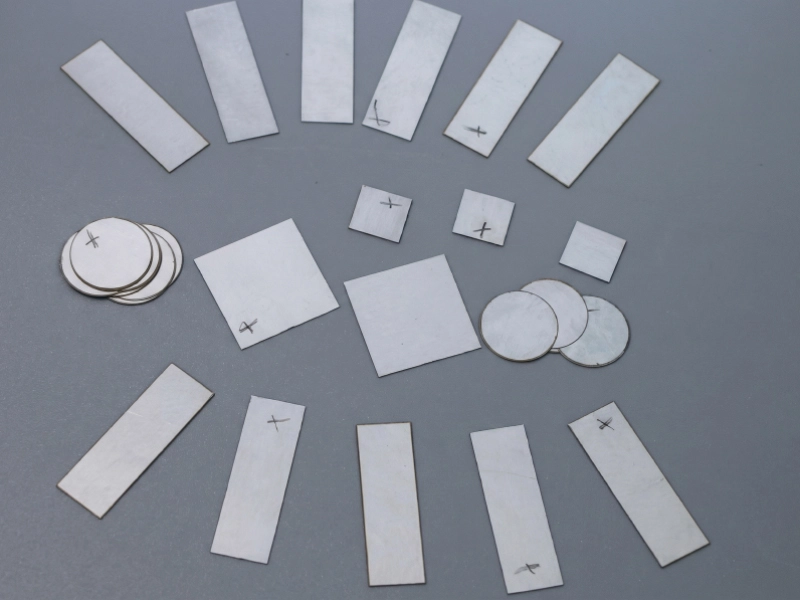
3. Both major surfaces of the specimen shall be coated with a metallic layer serving as electrodes. (BALAB Technology provides electrode coating services.)
4、The specimen shall be kept clean and dry.
Testing Standards
GB/T 6426-1999 Quasi-Static Test Method for Ferroelectric Hysteresis Loops of Ferroelectric Ceramic Materials
Test Results