
MatMeas DMS-1000 DMS-2000 Variable-Temperature Dielectric Impedance Spectrometer
Testing Function
Piezoelectric ceramics exhibit the piezoelectric effect only within a certain temperature range. There exists a critical temperature Tc; when the temperature exceeds Tc, a structural phase transition occurs in the piezoelectric ceramic. This critical temperature Tc is referred to as the Curie temperature.
Testing Principle
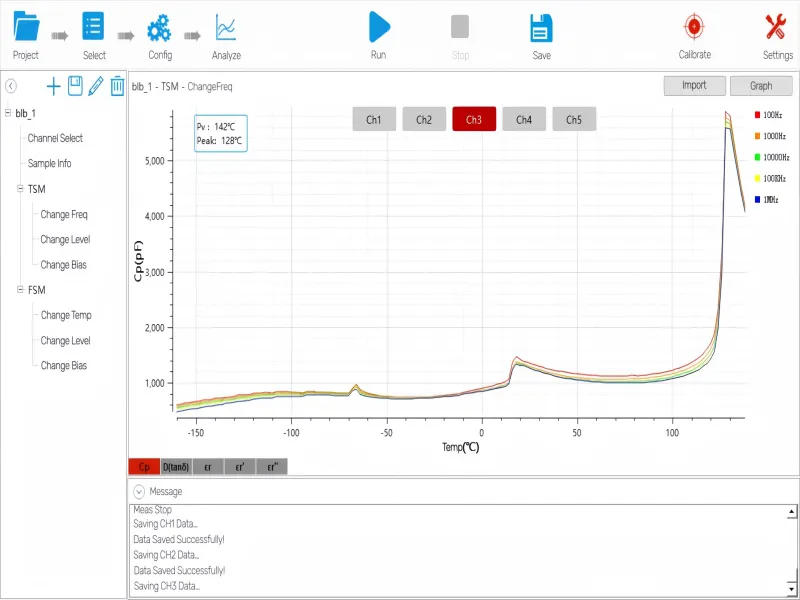
When the temperature exceeds the Curie temperature (Tc), piezoelectric ceramics enter the paraelectric phase, and both spontaneous polarization and piezoelectric properties disappear. At the Curie temperature, many physical properties of piezoelectric ceramic materials—such as permittivity, heat capacity, and the coefficient of thermal expansion—undergo abrupt changes. Therefore, determining the temperature corresponding to this abrupt change allows the Curie temperature of the piezoelectric ceramic material to be identified. The Curie temperature can be determined by detecting the abrupt change point of the sample permittivity, and it is recommended that an impedance analyzer be used to measure this transition point.
Testing Conditions
1. Measurement Error: ±1%
2. Impedance Analyzer Measurement Error: ±1%
3. Temperature Control Accuracy: ±0.5 °C
4. Heating/Cooling Rate: 1 °C/min – 10 °C/min, recommended 2–3 °C/min
Sample Requirements
1. Recommended Dimensions: φ20 mm × 1 mm
2. The specimen should be an unelectroded, unpoled thin sheet with electrodes (electrode coating service available).
3. The specimen should be kept clean and dry.
Testing Standards
GB/T 3389-2008 Test Methods for Properties of Piezoelectric Ceramic Materials — Measurement of Performance Parameters
Testing Principle
Under a constant electric field or an alternating electric field of sufficiently low frequency, the relative permittivity of an isotropic or quasi-isotropic dielectric medium is equal to the ratio of the capacitance of the capacitor to the capacitance of the same electrode configuration in vacuum, where the space between the electrodes and the surrounding region of the electrodes is completely filled with the dielectric medium.
Under a steady-state sinusoidal electric field, the relative complex permittivity is expressed as a dielectric constant represented by the complex quantity ε, as shown in the figure below:
Test Results